
In the ever-evolving world of software development, Node.js and TypeScript have emerged as powerful tools for building robust, scalable, and efficient back-end applications. As enterprises increasingly embrace modern technologies and methodologies, the demand for best practices in developing enterprise-grade back-end systems using these technologies has skyrocketed.
Enterprise-Grade Node.js and TypeScript Back-End Development
Modular Architecture
One of the fundamental principles of enterprise-grade back-end development with Node.js and TypeScript is adopting a modular architecture. This approach involves breaking down the application into smaller, reusable components or modules, each responsible for a specific task or functionality.
By following this principle, developers can:
- Enhance Code Organization: Modular architecture promotes better code organization, making it easier to navigate, maintain, and scale the codebase.
- Reusability: Modules can be reused across multiple projects, reducing duplication and promoting consistency.
- Testability: Modular code is easier to test, as each module can be tested in isolation, improving overall code quality and reliability.
// Example of a modular structure in a Node.js application
/src
  /controllers
    userController.ts
    productController.ts
  /services
    userService.ts
    productService.ts
  /models
    User.ts
    Product.ts
  /routes
    userRoutes.ts
    productRoutes.ts
  app.ts
Dependency Injection
Dependency injection is a software design pattern that promotes loose coupling between components by separating the construction and resolution of dependencies. In the context of Node.js and TypeScript, this practice helps manage dependencies more effectively and enhances code maintainability and testability.
Benefits of dependency injection include:
- Decoupling: Components become less dependent on specific implementations, making them more reusable and easier to modify.
- Testability: Dependencies can be easily mocked or replaced during testing, enabling better unit testing and isolation.
- Modular Design: With dependency injection, components are more modular and easier to reason about, leading to better code organization and maintainability.
// Example of dependency injection in a TypeScript class
import UserService from './userService';

class UserController {
  private userService: UserService;

  constructor(userService: UserService) {
    this.userService = userService;
  }

  async getUserById(id: string) {
    return this.userService.getUserById(id);
  }
}
Asynchronous Programming with Promises and Async/Await
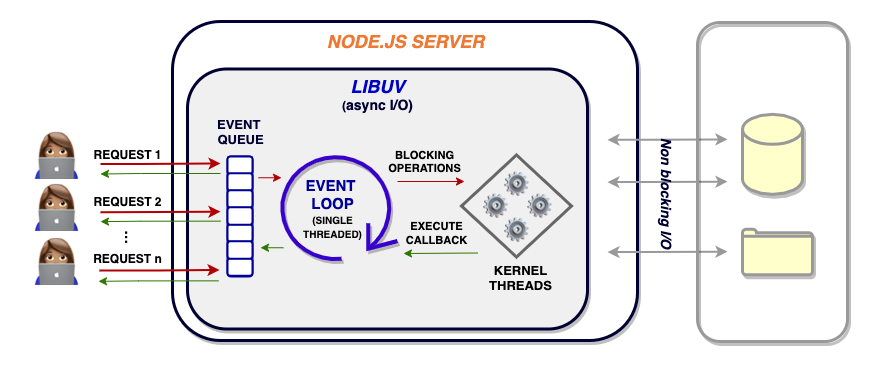
Node.js is built on an event-driven, non-blocking I/O model, making asynchronous programming a crucial aspect of back-end development. TypeScript, being a superset of JavaScript, seamlessly supports asynchronous programming patterns like Promises and async/await.
Using Promises and async/await provides several benefits:
- Improved Readability: Asynchronous code becomes more readable and easier to reason about, reducing the need for nested callback functions (known as the "callback hell").
- Error Handling: Promises and async/await offer better error handling mechanisms, making it easier to catch and handle exceptions.
- Improved Performance: Asynchronous programming allows the application to handle multiple tasks concurrently, leading to better utilization of system resources and improved performance.
// Example of using async/await with TypeScript
import  from 'fs';

async function readFile(filePath: string): Promise {
  try {
    const data = await fs.readFile(filePath, 'utf8');
    return data;
  } catch (err) {
    throw new Error(`Failed to read file: $`);
  }
}
Robust Error Handling
Proper error handling is a critical aspect of building reliable and resilient back-end applications. Node.js and TypeScript provide several mechanisms for handling errors effectively, including try-catch blocks, error middleware, and custom error classes.
By implementing robust error handling strategies, developers can:
- Improve User Experience: Properly handled errors can provide meaningful feedback to users, enhancing the overall user experience.
- Facilitate Debugging: Well-structured error messages and stack traces make it easier to identify and fix issues during development and in production environments.
- Enhance Resilience: Proper error handling allows applications to gracefully recover from errors and continue operating, improving overall system reliability.
// Example of a custom error class in TypeScript
class CustomError extends Error {
  constructor(message: string, public code: number) {
    super(message);
    this.name = 'CustomError';
  }
}

// Example of using the custom error class
throw new CustomError('Invalid input', 400);
Unit Testing
Unit testing is an essential practice in enterprise-grade back-end development, as it helps ensure the quality and reliability of individual components or units of code. Node.js and TypeScript provide excellent support for unit testing through various testing frameworks and tools, such as Jest, Mocha, and Chai.
Benefits of implementing unit testing include:
- Early Bug Detection: Unit tests help catch bugs early in the development cycle, reducing the cost and effort required to fix them later.
- Refactoring Confidence: With comprehensive unit tests in place, developers can confidently refactor code without introducing regressions.
- Documentation: Well-written unit tests can serve as documentation, illustrating the expected behavior of the code under various conditions.
// Example of a unit test using Jest for a TypeScript function
import  from './math';

describe('sum', () => {
  it('should add two numbers correctly', () => {
    expect(sum(2, 3)).toBe(5);
  });

  it('should handle negative numbers', () => {
    expect(sum(-2, 3)).toBe(1);
  });
});
Linting and Code Formatting
Linting and code formatting tools help maintain consistent code style and quality across the codebase. For Node.js and TypeScript projects, popular tools like ESLint, TSLint, and Prettier can be integrated into the development workflow to enforce coding standards and best practices.
Benefits of using linting and code formatting tools include:
- Consistent Code Style: Enforcing a consistent code style across the entire codebase improves readability and maintainability.
- Identifying Potential Issues: Linting tools can catch potential bugs, coding anti-patterns, and other issues during development, reducing the likelihood of introducing errors.
- Improved Collaboration: With shared coding standards, collaboration among team members becomes more efficient, reducing merge conflicts and miscommunication.
// Example .eslintrc.js configuration file
module.exports = {
  env: {
    browser: true,
    es6: true,
    node: true,
  },
  extends: [
    'airbnb-base',
    'plugin:@typescript-eslint/recommended',
  ],
  parser: '@typescript-eslint/parser',
  parserOptions: {
    ecmaVersion: 2020,
    sourceType: 'module',
  },
  plugins: [
    '@typescript-eslint',
  ],
  rules: {
    // Custom rules go here
  },
};
Building Robust Back-End Applications with Node.js and TypeScript

RESTful API Design
Representational State Transfer (REST) is an architectural style for building web services and APIs. When developing enterprise back-end applications with Node.js and TypeScript, following RESTful principles can lead to more scalable, maintainable, and interoperable systems.
Key principles of RESTful API design include:
- Resource-Based Architecture: APIs should be designed around resources, with URLs representing the logical structure of those resources.
- Stateless Communication: Each request should contain all the necessary information for the server to process it, without relying on stored client context.
- Standard HTTP Methods: APIs should leverage standard HTTP methods (GET, POST, PUT, DELETE) to perform operations on resources.
- Hypermedia Controls: APIs should provide links and actions that guide clients through the application's state transitions.
// Example RESTful API endpoint using Express and TypeScript
import express,  from 'express';
import User from './models/User';

const router = express.Router();

// GET /users
router.get('/users', async (req: Request, res: Response) => {
  try {
    const users = await User.find();
    res.json(users);
  } catch (err) {
    res.status(500).json();
  }
});

// POST /users
router.post('/users', async (req: Request, res: Response) => {
  try {
    const newUser = new User(req.body);
    await newUser.save();
    res.status(201).json(newUser);
  } catch (err) {
    res.status(400).json();
  }
});

export default router;
Database Integration
Enterprise back-end applications often rely on databases to store and manage data efficiently. When integrating databases with Node.js and TypeScript applications, developers have a variety of options, including relational databases (e.g., PostgreSQL, MySQL) and NoSQL databases (e.g., MongoDB, Redis).
Key considerations for database integration in Node.js and TypeScript projects include:
- ORM/ODM Libraries: Object-Relational Mapping (ORM) and Object-Document Mapping (ODM) libraries like TypeORM, Sequelize, and Mongoose simplify database interactions by abstracting away low-level SQL queries.
- Connection Pooling: Managing database connections efficiently through connection pooling can improve performance and scalability.
- Data Modeling: Designing appropriate data models and relationships based on the application's requirements is crucial for maintaining data consistency and integrity.
// Example database model using TypeORM in TypeScript
import  from 'typeorm';

@Entity()
class User {
  @PrimaryGeneratedColumn()
  id: number;

  @Column()
  name: string;

  @Column()
  email: string;
}

export default User;
Authentication and Authorization
Securing enterprise back-end applications involves implementing robust authentication and authorization mechanisms to protect sensitive data and resources. Node.js and TypeScript offer various tools and libraries for handling user authentication, role-based access control, and token-based security.
Common practices for authentication and authorization in Node.js and TypeScript applications include:
- JWT Authentication: Using JSON Web Tokens (JWT) for secure user authentication and session management.
- Role-Based Access Control (RBAC): Defining roles and permissions to restrict access to certain endpoints or resources based on user roles.
- OAuth Integration: Integrating OAuth providers for third-party authentication and authorization.
- Secure Password Storage: Safely storing user passwords using hashing algorithms like bcrypt to prevent unauthorized access.
// Example JWT authentication middleware in TypeScript
import  from 'express';
import jwt from 'jsonwebtoken';

const authenticateToken = (req: Request, res: Response, next: NextFunction) => {
  const token = req.headers['authorization']?.split(' ')[1];

  if (!token) {
    return res.status(401).json();
  }

  jwt.verify(token, process.env.JWT_SECRET, (err, user) => {
    if (err) {
      return res.status(403).json();
    }
    req.user = user;
    next();
  });
};

export default authenticateToken;
Scalability and Performance Optimization
Ensuring scalability and optimal performance is essential for enterprise back-end applications that are expected to handle a large volume of traffic and concurrent users. Node.js and TypeScript provide several strategies for improving scalability and performance, such as load balancing, caching, and asynchronous processing.
Key techniques for optimizing scalability and performance in Node.js and TypeScript applications include:
- Horizontal Scaling: Distributing incoming requests across multiple server instances to handle increased load effectively.
- Caching Strategies: Implementing caching mechanisms (e.g., Redis, Memcached) to store frequently accessed data and reduce response times.
- Asynchronous Processing: Leveraging asynchronous programming patterns to handle I/O-bound operations efficiently and prevent blocking the event loop.
- Monitoring and Profiling: Using monitoring tools (e.g., New Relic, Datadog) to identify performance bottlenecks and optimize code and infrastructure.
// Example of caching with Redis in TypeScript
import redis from 'redis';

const client = redis.createClient();

const cacheMiddleware = (req, res, next) => {
  const key = req.originalUrl;
  client.get(key, (err, data) => {
    if (err) throw err;

    if (data !== null) {
      res.send(data);
    } else {
      next();
    }
  });
};

export default cacheMiddleware;
Video
Conclusion
In conclusion, developing enterprise-grade back-end applications with Node.js and TypeScript offers a powerful combination of performance, scalability, and maintainability. By following best practices such as utilizing Promises and async/await for asynchronous operations, implementing robust error handling, conducting thorough unit testing, and integrating linting and code formatting tools, developers can build reliable and efficient back-end systems.
Furthermore, focusing on building robust back-end applications with RESTful API design, seamless database integration, secure authentication and authorization mechanisms, and scalability and performance optimization strategies ensures that enterprise applications meet the demands of modern business environments.
Overall, Node.js and TypeScript provide a versatile and feature-rich platform for architecting and deploying sophisticated back-end solutions that drive innovation and success in the enterprise sector. By embracing these technologies and adopting industry best practices, developers can elevate their back-end development skills and deliver exceptional value to organizations seeking cutting-edge software solutions.






0 Comments